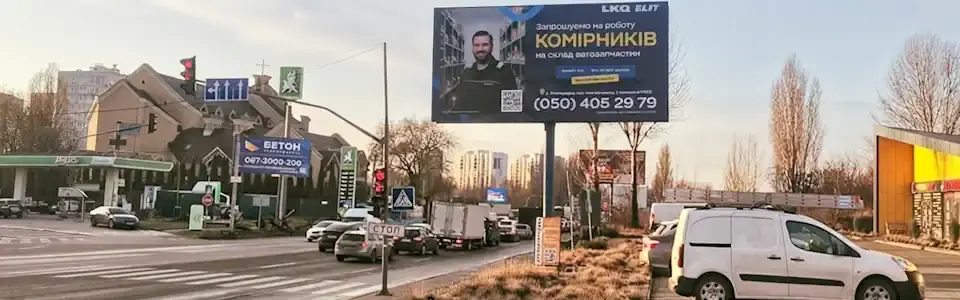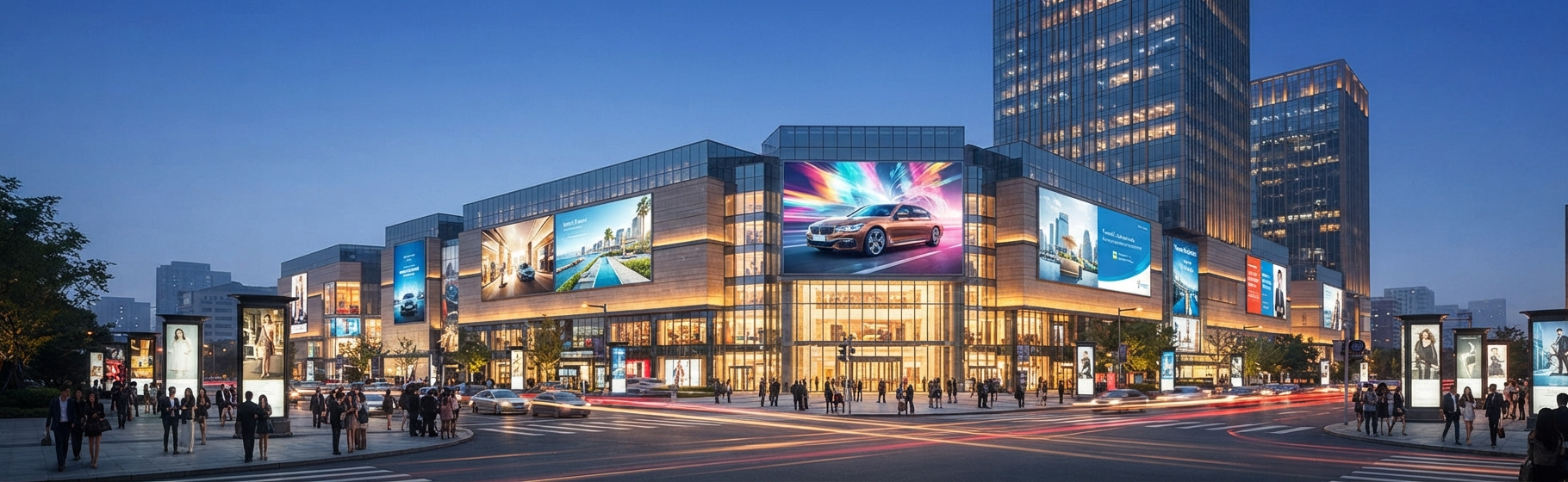

Renting an advertising face simply "by a mall entrance" or "across from a well-known business center" does not automatically provide access to a high-value audience, whether the campaign runs in Kyiv, Odesa, Lviv, Dnipro, or another Ukrainian city. If the ad faces people leaving a parking lot while the offer asks them to stop for lunch right away, the budget is being spent in the wrong context.
Effective out-of-home advertising around major destinations starts with an analysis of movement: who can see the advertising face, where that person is going, and which action is realistic after the contact. For nationwide campaigns, this analysis covers the urban setting, media format, and audience behavior in each location.
Why can a location near a shopping mall deliver a valuable customer contact?
People near a shopping mall are already making choices about purchases, entertainment, meetings, or dining. This shortens the path between an advertising message and a possible action. For a store, restaurant, service provider, or entertainment venue, advertising faces along access roads and pedestrian routes to the mall can be especially relevant.
Mall visitors have different motivations and spending patterns. For example, a media plan may separately consider weekend family traffic near Respublika Park in Kyiv, the evening flow near Most-City in Dnipro, or the mix of tourists and shoppers near Forum Lviv. Each audience responds to a different set of offers, so the flow must match the specific product.
A useful media planning rule is simple: a location has value when the audience can understand the offer, remember the brand, and move to the next action without unnecessary effort. For a tenant inside the mall, that action may be an immediate visit. For an automotive brand, bank, or residential project, it may be a later search.
Where should advertising be placed around a shopping mall?
Strong locations develop along approach routes, entrances, and exits. Each point represents a separate contact moment, which means the same offer can perform differently at nearby advertising faces.
Review these factors during location selection:
- the primary access roads and the direction of the target flow;
- intersections where vehicles slow down and the advertising face remains visible longer;
- parking entrances and exits, especially for products with a delayed decision;
- public transportation stops and crossings on the way to the main entrances;
- pedestrian connections between the mall, residential districts, and office buildings;
- visibility around trees, signs, utility poles, and other structures.
An advertising face before the entrance is suitable for a short message about a store or event inside the mall. At the exit, offers that people can revisit later are usually more relevant. This distinction can matter more than the physical distance between the media structure and the building.
How does hybrid work change traffic near business centers?
Business center locations require an analysis of the working week, time of day, and tenant mix. Hybrid schedules make office flows uneven: Tuesday through Thursday can be busier than Friday. Treat this as a planning hypothesis and verify it with data from the specific property because attendance patterns depend on its tenant companies.
A business district also produces different daily scenarios: morning arrivals, lunch routes, short coffee breaks, meetings, and evening departures. Coffee, delivery, financial services, and professional products may fit the morning flow. Restaurants and nearby stores become more relevant at lunchtime, while leisure, fitness, and after-work shopping fit the evening context.
The tenant mix provides a clearer audience signal than the district's general prestige. A business center with large corporate offices, a coworking space, and a mixed-tenant complex produce different routes. Before booking, walk the location and drive past it during the periods when the main contact is expected.
What is the difference between OOH and DOOH?
OOH and DOOH reach the same urban audience while giving advertisers different ways to manage the contact. OOH means traditional out-of-home advertising on static structures. DOOH means digital out-of-home advertising on screens with messages that can change.
The main differences between the formats are:
- Objective: OOH maintains a constant presence along a route and builds recognition, while DOOH allows creative to change for a specific time of day or day of the week.
- Attention focus: stable visibility, traffic direction, and concise creative are critical for OOH. DOOH also requires an appropriate display schedule and a message that fits the specific moment.
- Synergy: a static OOH face supports the brand's baseline presence, while a digital DOOH screen adapts the current offer to the situation.
Near a business center, DOOH can show one offer to the morning flow and another in the evening. Near a mall, it works well for changing promotions, events, and product categories. A static billboard or citylight suits a brand that needs sustained visibility along a specific route.
How should a location be evaluated before booking?
A reliable location assessment combines operator data with an on-site review. A photo of the advertising face is useful, but it does not reveal the full route, the actual competition for attention, or visibility obstacles encountered in motion.
A practical audit should cover:
- the direction and composition of the flow on the relevant day and time;
- the distance from which the main message can be read;
- the viewing angle for a driver or pedestrian;
- the natural contact duration while moving or waiting;
- nearby advertising faces, signs, and visual clutter;
- the ability to connect the message with an entrance, turn, or another clear action;
- availability of the required advertising face for the planned period.
Compare locations with one consistent set of criteria: audience fit, visibility, context, traffic direction, and format suitability. This approach prevents a team from choosing the most expensive or best-known address solely because of its reputation.
How can brands get more from advertising near malls and business centers?
The right location has a major influence on campaign performance. Assessing actual traffic, visibility, and route context in another city is difficult without local information, especially when the media plan covers several regions.
At Billboards, we do not sell addresses blindly. We analyze routes, audiences, and your advertising objective for every location. Our team works with every major format, from traditional OOH structures to DOOH screens, and manages turnkey campaigns across Ukraine.
Planning to reach audiences near leading malls or business districts in Kyiv, Lviv, Odesa, Dnipro, or other cities? Submit a request on the Billboards website to receive a free custom location plan aligned with your business goals.