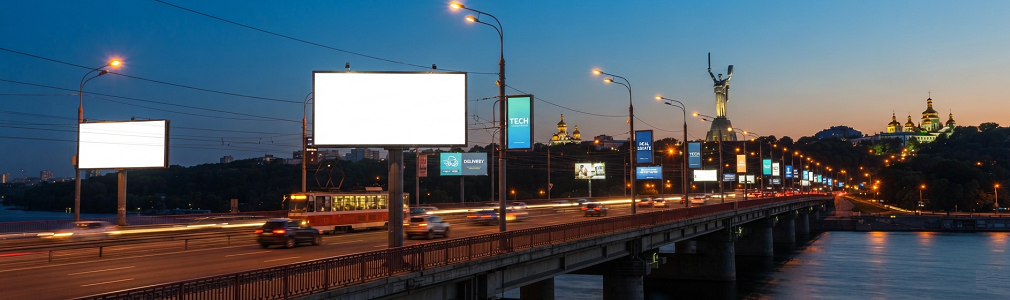

The right billboard location is a place where your message reaches the right audience at the right moment and remains visible enough to be understood quickly. A smart billboard selection starts with the customer's route, then moves to traffic, the side of the structure, cost, and availability.
If a campaign begins with address research, it is convenient to review available faces on the out-door advertising on billboards page and compare every location with the movement map of your audience. This saves time: the marketer filters out random addresses before requesting a commercial offer.
Where should billboard selection start?
Billboard selection starts with answers to a few questions: who should see the ad, where that person is going, and what action you expect after the contact. The same billboard may suit brand awareness well and still be weak for a campaign that needs to bring people to a specific point of sale.
For a local coffee shop, pharmacy, car service, or store, proximity to the route people already use near the business matters most. For a residential complex, medical center, or large retail chain, wider coverage can work better: main roads, district entrances, and intersections with repeated daily contact.
Before looking for faces, write the campaign task in one sentence. For example: “increase awareness of a new branch among district residents,” “remind drivers about a seasonal offer on the way to a shopping center,” or “support a brand launch in the city.” A clear task immediately narrows billboard selection to several logical zones.
How can you assess billboard traffic without guesswork?
Billboard traffic should be assessed through contact quality: whether the right audience sees the face and whether they have enough time to read the message. OTS means the number of potential contacts with an advertising face, but a marketer needs to understand who is inside that flow and how much attention they can give.
Ask the contractor for a detailed description of the situation around the structure. It is especially useful to check:
- the main traffic direction: toward the center, away from the center, toward residential areas, retail zones, or office districts;
- the audience type: drivers, public transport passengers, pedestrians, shopping center visitors, district residents;
- traffic speed: a slower flow gives more time to read, while a faster flow requires a very simple layout;
- stopping points: traffic lights, congestion, pedestrian crossings, parking exits;
- contact repetition: a daily route is often more valuable than a random one-time view;
- advertising surroundings: nearby faces, signs, trees, and facades that may take attention away.
Heavy traffic near a complex junction may produce weaker contact than a calmer address before a traffic light. The person should be able to understand the key message without effort.
Why do side A and side B of a billboard affect ad performance?
Side A and side B of a billboard show from which traffic direction people see the advertising face, so two sides of the same structure can perform differently. Price, reach, and commercial value depend on the flow each side faces.
Side labels should be checked using a route scheme and photos taken from the direction of movement. Operators may label sides differently, so the letter in the table should be secondary; the actual viewing direction matters most. If your customer drives toward an office center in the morning, the opposite-facing side may gather a different audience.
At this stage, think in contact scenarios instead of simply reviewing addresses from a price list. For ad performance, ask where the person is before contact, where they move afterward, and whether they can take the desired action without friction. For example, a face on the exit from a district may work better for a morning reminder, while a side facing the entrance may suit the evening return home.
How should you check ad visibility before booking?
Ad visibility should be checked before approving an address: a close-up photo of the structure does not show how a driver or pedestrian sees the creative from the real route. You need photos from the distance where the person first notices the face and from the point where the main message should be readable.
Assess the angle, height, obstacles, lighting, background, and competition for attention. A tree, road sign, bus stop, or busy facade can reduce readability. In the evening, lighting and contrast become important; during the day, sunlight, shadows, and visual noise matter more.
Also check whether the location matches the creative format. If the face stands on a fast road, use a short headline, one strong visual accent, and a simple call to action. Near a traffic light with slower movement, you can add more detail, but the text still has to be read quickly.
Where should outdoor advertising be placed for different business goals?
There is no universal answer to “where should outdoor advertising be placed”: the right zone depends on campaign goals, sales geography, and audience behavior. To place ads on billboards without random choices, first define the commercial task, then outline contact areas, and then compare available faces by traffic, traffic direction, and visibility.
Different goals require different selection logic:
- local businesses look for faces near the point of sale or on the way to it;
- retail chains look at district coverage where stores already exist or are planned;
- developers assess routes to the sales office, construction site, and districts where buyers may come from;
- medical, education, and service companies often work with routes around residential areas and transport hubs;
- event campaigns need visible locations on routes to the venue or in areas where the audience spends free time.
The practical approach is simple: first map the audience, then mark contact zones, and after that select specific faces. This way, the budget goes to addresses that support the business logic of the campaign.
How can you match the location with the billboard creative?
The same address can be strong or weak depending on the creative: long copy needs slower contact, while a short brand message handles fast traffic better. Billboard selection should happen together with an assessment of the future design, because the location sets the reading conditions.
If the layout contains many small elements, even a strong address may lose part of its potential. Billboards work better with short phrases, one large contrasting object, a clear offer, and one main contact point: website, phone number, QR code, or direction to the location. A QR code should be used only where a person can interact with it safely; on a high-speed road, that element often becomes unnecessary.
Look at the background as well. A red layout may get lost next to bright signs, a light design may fade on a light facade, and small text may fail on a high-speed section. Location and design are best approved together: first the rough creative idea, then final face selection, and then layout adaptation for specific addresses.
Marketer checklist before approving a face
Before booking, prepare a short profile for each location so you can compare faces by the same criteria. This reduces the risk of choosing emotionally because an address “feels prestigious.”
An internal scoring table works well: separate columns for audience, visibility, traffic direction, creative fit, and risks. Team discussions then become specific: instead of “we like this address,” you get reasons explaining why the face supports or weakens the campaign.
Check these points:
- the campaign goal is specific: reach, store traffic, launch, promotion support, or reminder;
- the audience is described through routes, districts, travel time, and transport type;
- the address, traffic direction, and side of the structure are confirmed by photos or a scheme;
- ad visibility is assessed from the real contact distance; a close-up photo is used as supporting material;
- the surrounding advertising environment does not overload the face;
- the creative matches traffic speed and reading conditions;
- the budget and placement period match the role of this location in the campaign.
If any point raises doubts, ask the contractor an additional question or compare the address with alternatives. A strong location passes a logical test: who will see the ad, when exactly, from what distance, and what they should do after contact.
To wrap up
A billboard location affects the result more than it may seem while reviewing a price list. A marketer should look beyond the district name and examine the audience route, traffic direction, visibility, advertising surroundings, creative fit, and business goal. This checklist helps choose a face calmly, with clear reasoning, and without overpaying for addresses that do not support the brand's task.
Our company provides turnkey outdoor advertising placement. By contacting the Billboards advertising agency, the client receives a complete service for planning and implementing an OOH outdoor advertising campaign: we carefully select locations and advertising structures according to the client's needs and creative concept, develop the design layout, print materials, place the ad on advertising structures, and provide the photo report specified in the contract after placement. If you need this service, feel free to contact our advertising agency.